Em/D guitar chord
- Tap a note to hear it
- Arrows change position
- Fingers, notes or intervals
- Play the chord
About Em/D
Em/D gives the bass its own instruction: keep the upper chord, but make the lowest note. The slash separates those two jobs.
D is not in the upper triad; it completes a minor seventh chord with its flat seventh lowest. Hold the upper chord steady and move only the bass. That low line can connect nearby chords without jumping root to root.
Also written Em over D or Em with D in the bass.
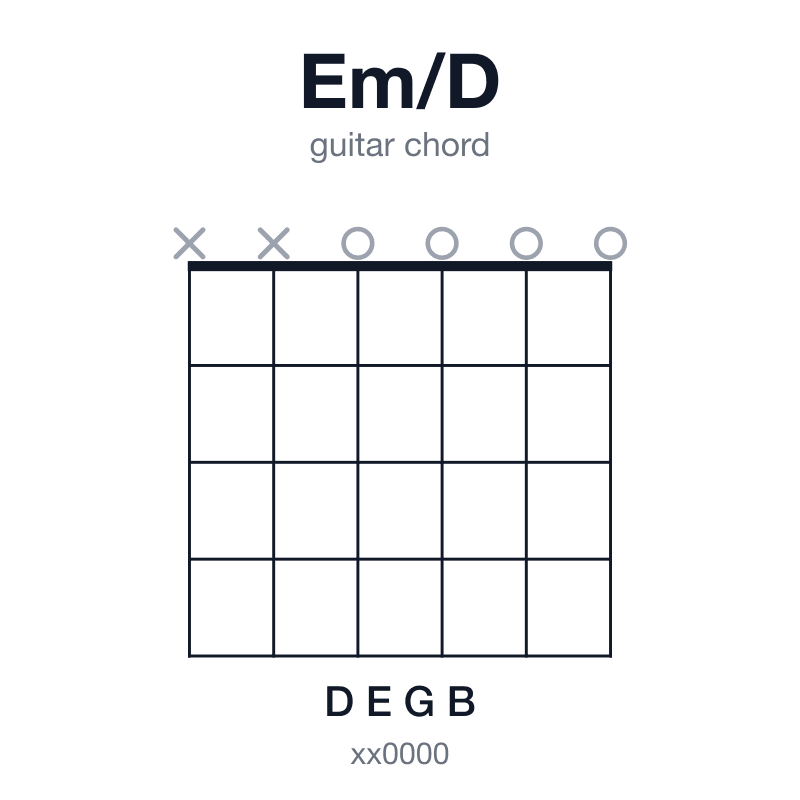
How to use Em/D
In which keys. Every note of Em/D belongs to C major (the iii), D major (the ii), E minor (the i), G major (the vi), A minor (the v) and B minor (the iv).
What to play over Em/D
Useful scales
- +A
Contains Em/D and adds eleventh.
- +ABb
Contains Em/D and adds eleventh and sharp eleventh.
- +F#AC
Contains Em/D and adds ninth, eleventh and flat thirteenth.
- +F#AC#
Contains Em/D and adds ninth, eleventh and thirteenth.
- +FAC
Contains Em/D and adds flat ninth, eleventh and flat thirteenth.
Chords near Em/D
Change one note
6th in bass 3rd inversion 3rd inversion 3rd inversion
The common shapes and the derived voicings come from different places, and both are explained in how this site is built.