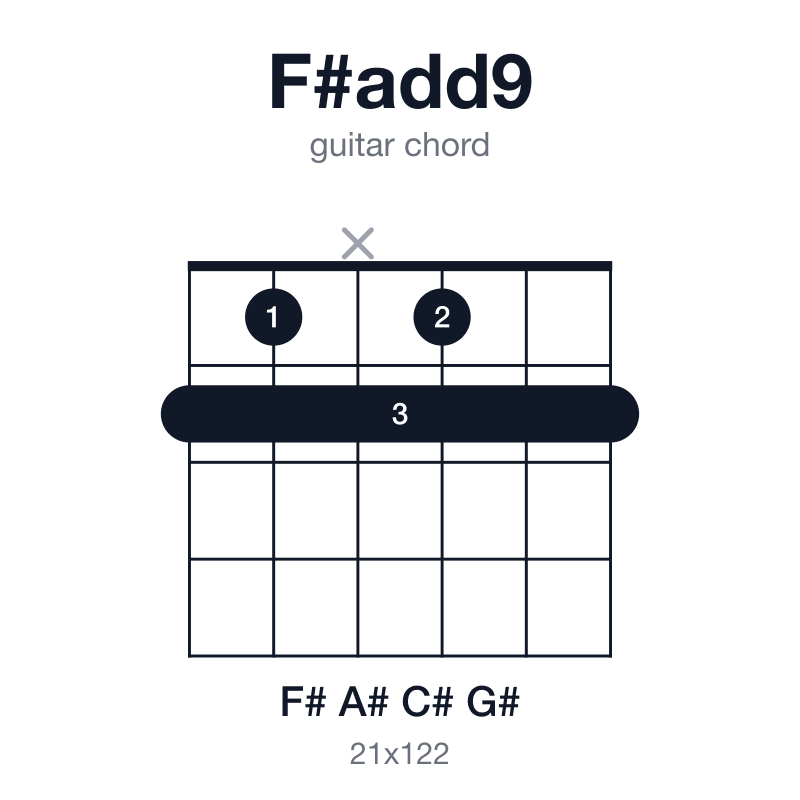
The standard grips this chord is usually shown with.
F#add9 is F#, A#, C# and G#, a add nine. The shape this page opens on is written 21x122, lowest string first.
Note by note. F# is the root, A# is the major third, C# is the fifth and G# is the ninth.

Also written F#(add9), F#add2 or F# add nine. The same chord either way; which spelling you meet depends on who wrote the chart.
There are 5 common shapes for F#add9 on the guitar, and 21 derived voicings in 2 families.
One note away. Change a single note of F#add9 and you have F# (with one note taken away), F#sus2 (with one note taken away), F#sus2sus4 (with one note moved), F#maj7 (with one note moved), F#maj9 (with one note added) or F#madd9 (with one note moved).
In which keys. Every note of F#add9 belongs to C# major (the IV), Eb minor (the ♭III), F# major (the I), Ab minor (the ♭VII), Bb minor (the ♭VI) and B major (the V).
The common shapes, written lowest string first: 21x122, xx43x4, x98696, x98x99, 14-13-x-13-14-x.
Under the hand. None of the shapes for F#add9 uses an open string, so every one of them is movable; the lowest sits at the 1st fret. 2 of the 5 need a barre. Together they cover the neck from the 1st fret to the 14th.
Drop 2. A close-position chord with the second voice from the top lowered an octave. Sits on four adjacent strings. F#add9 has xx4324, 4443xx, xx6676, x-11-11-11-11-x, x1412x, x4637x, 6966xx, x9869x.
Drop 3. The third voice from the top lowered an octave. The dropped voice becomes the bass, which is why a string is skipped. F#add9 has x1x122, 4x432x, x4x374, x9x696, 6x667x, 9-x-8-11-9-x, x-11-x-11-11-9, 14-x-11-13-11-x.
What kind of chord this is. F#add9 is a major chord — root, major third, fifth. major chords on every root, and what they are for.
The common shapes and the derived voicings come from different places, and both are explained in where the chords and the theory come from.
Shows each chord the way this style would voice it, and marks which of its alternatives belong to the idiom.