Ealt
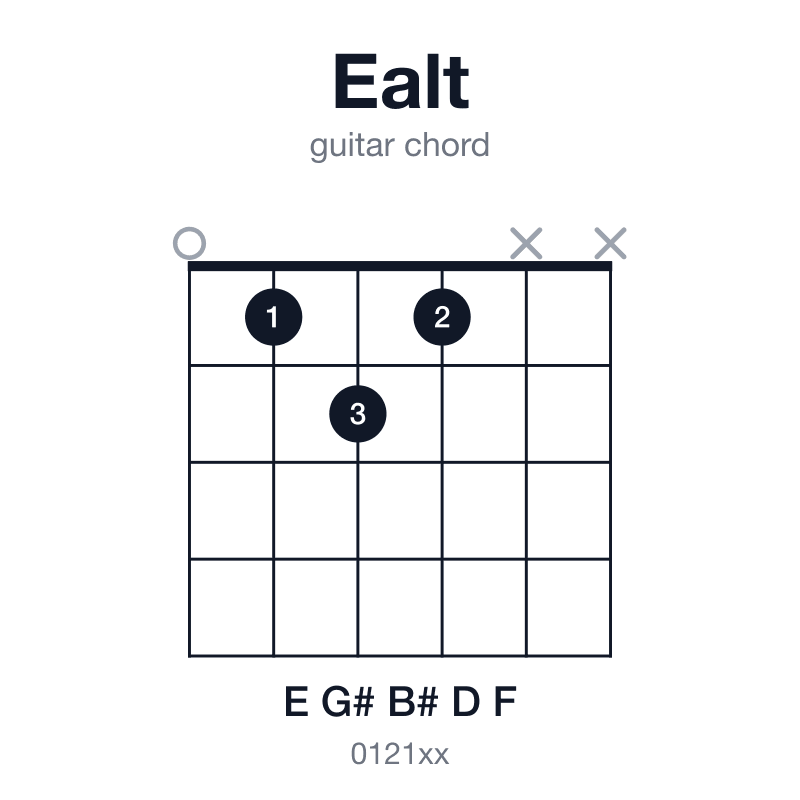
The standard grips this chord is usually shown with.
- Tap a note to hear it
- Arrows change position
- Fingers, notes or intervals
- Play the chord
About Ealt
Ealt is E, G#, B#, D and F, a altered dominant. The shape this page opens on is written 0121xx, lowest string first.
There are 9 common shapes for Ealt on the guitar, and 29 derived voicings in 3 families.
The common shapes, written lowest string first: 0121xx, xx2354, x76x56, x76996, x78990, x78997, 12-11-x-13-11-12, x-x-14-13-11-12, 12-13-14-13-x-12.
Shell. Root, third and seventh: the guide tones fix the quality, so the fifth is dropped. That is what leaves a string free, so pick a tension to put on top. Ealt has xx2131, 0565xx, x7676x, 12-11-12-10-x-x, x-x-14-13-15-13, 0x011x, x7x798, 12-x-12-13-13-x.
Rootless. The root left to the bass player. Frees a finger for a tension. Ealt has xx0111, x3313x, xx3534, x5656x, xx6768, x-x-10-10-9-10, x-x-12-13-13-13, x-15-15-13-15-x.
Open string. An open string left ringing against a fretted grip. Because it costs no finger, it sounds a note the closed shape has none left for -- a tension on top, or a pedal root underneath. Either a familiar grip with open strings added, or a shape so sparse the open strings carry the chord. These belong to their key rather than to a shape, so D, A, G and E have many and Eb a handful. Ealt has 05656x, 050564, 0x3534, x56560.
Tensions. A shell of Ealt, root, third and seventh, leaves a string free, and the tones that belong over it are the #11 (A#).
The common shapes and the derived voicings come from different places, and both are explained in where the chords and the theory come from.