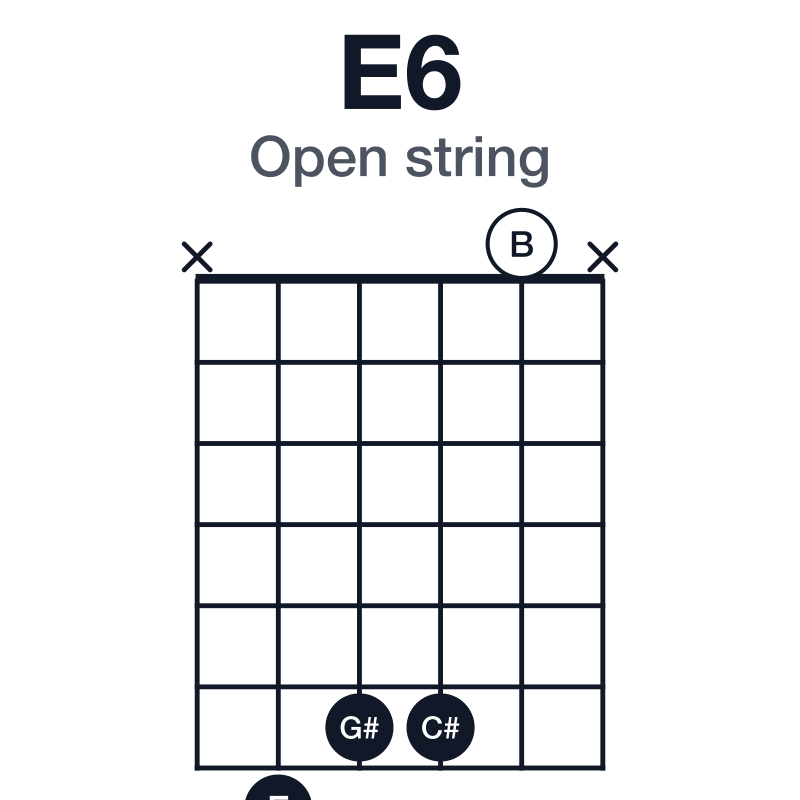
E6 guitar chord

Open string · Root position
1 of 3
Inversion
  • Tap a note to hear it
  • Arrows change position
  • Fingers, notes or intervals
  • Play the chord

About E6 — open string voicings

E6 is E, G#, B and C#. It keeps the triad and adds the .

In the pair below, the 6th replaces a repeated root. Compare with E6 to hear that one note change.

Hear the change

One repeated root moves down three frets to the sixth. The other notes stay the same.

When is home, jazz players often use E6 or . E6 has ; has instead.

Also written Emaj6, EM6 or E major 6.

E6 open string guitar chord diagram: E, G#, B, C#, played x7660x
E6 open string guitar chord voicing: x-7-6-6-0-x.

What is an open-string voicing

Open-string voicing
×EADGBE

An open string adds a note without a finger: a tension on top or a pedal below. These belong to their key and cannot be moved up the neck.

How to use E6

1With a passing diminished chord

I – vii°7 – I

Alternate E6 with D#dim7 and the pair always sounds smooth: that diminished chord is the V7♭9 with its root left out, so the two chords are really I and V. Harmonising a melody this way puts the sixth chord under its own notes and the diminished chord between them.

Listen for: Every voice steps to its neighbour, a half or a whole step down, and back. Nothing leaps.

Heard in“Softly, as in a Morning Sunrise” (the same device on a minor sixth)

2The line cliché in major

I in E major

The line cliché works on a major chord too, though the minor form is far more common: hold E and walk one voice down from the root, a half step at a time. E6 is the last step, where the seventh has dropped to the sixth.

Listen for: Only one note moves: root, major seventh, flat seventh, sixth.

Other uses

From the books, without a worked example

In which keys. Every note of E6 belongs to C# minor, E major, F# minor, Ab minor, A major and B major.

What to play over E6

Useful scales

  • +F#

    Contains E6 and adds second.

  • +F#AD#

    Contains E6 and adds second, fourth and major seventh.

  • +F#A#D#

    Contains E6 and adds second, sharp eleventh and major seventh.

  • +F#AD

    Adds second, fourth and flat seventh. The flat seventh pushes the sound toward a dominant chord.

  • +F#A#D

    Adds second, sharp eleventh and flat seventh, for a dominant sharp-eleventh color.

Every scale

Chords near E6

Remove a note

Change one note

  • 1st inversion
    1st inversion
    C# → D#

    Replace the sixth with the major seventh.

    See Emaj7 chord →
  • open strings
    open strings
    G# → G

    Lower the major third to the minor third.

    See Em6 chord →
  • 1st inversion
    1st inversion
    C# → D

    Raise the sixth to the flat seventh.

    See E7 chord →

Add a note

Major chords on every root

The common shapes and the derived voicings come from different places, and both are explained in how this site is built.

Midi Settings

7.5
Play Style
One pass of the pick from the lowest string up, everything left ringing.
Instrument
350
150

Style

Shows each chord the way this style would voice it, and marks which of its alternatives belong to the idiom.

Layout

Left Handed Mode